

Horror movies are known for their ability to translate brutal slashings into social commentary that reflects the general opinion of the time period. The antagonists in the movies are analogies for the ‘villains’ in real life, and LGBTQ+ individuals have a long history in horror movies, but not as the protagonist.
While “Silence of the Lambs” and “Psycho” are a long way from good representation, their impact on both the horror genre and the LGBTQ+ community is undeniable. It doesn’t take a genius to see how queer people can relate to feeling ‘othered’ or outcast by society, just like so many horror antagonists.
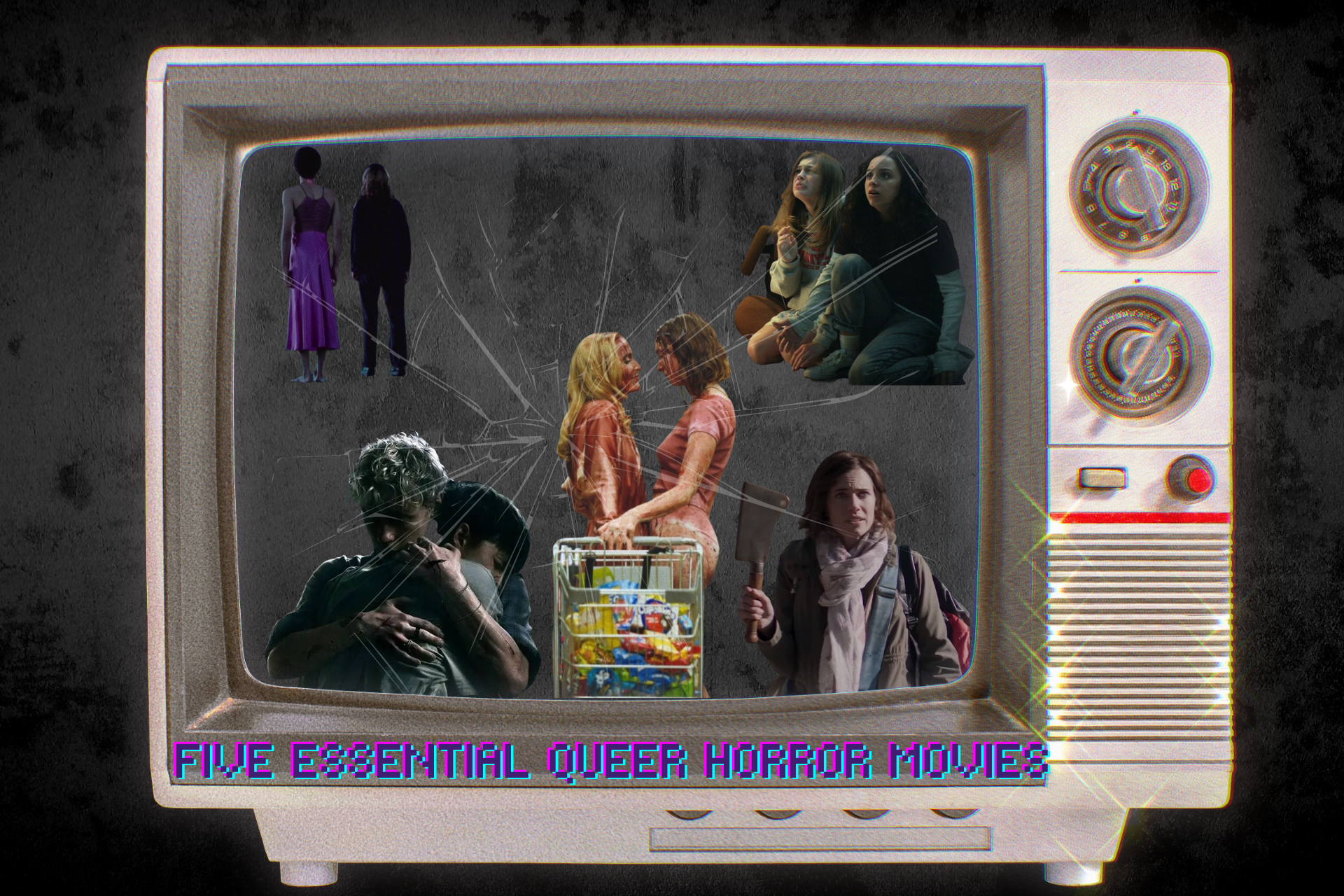
In today’s film scene, the queer community doesn’t have to settle for background roles or lage-old stereotypes. Here are five movies where queer characters move the story forward. No queerbaiting here. Only canon characters or relationships; happy endings are sold separately.
“Teenage Sex and Death at Camp Miasma”
Released this past August, “Teenage Sex and Death at Camp Miasma” centers around queer filmmaker Kris Williams as she tries to greenlight a remake of the classic “Camp Miasma” film with the original final girl, Billy Presely. Things take a dark turn when Kris realizes just how real the events of “Camp Miasma” were.
Hannah Eibinder and Gillian Anderson as Williams and Presley are definite highlights of the film and bring the bizarre premise to life. The movie is the perfect way to soft-launch the winter season, and for concerned viewers, yes, they do get their happily ever after, and quite literally walk off into the sunset hand in hand.
“Fear Street” is a Netflix original trilogy starring Kiana Madeira and Olivia Scott Welch as the leading lesbians.
The first and third movies, “Fear Street 1994” and “Fear Street 1666,” are led by the couple Deena Johnson and Sam Fraser as they fight against the supernatural killers hunting them and their friends down, only to uncover an even more sinister secret haunting their town. The middle movie, “Fear Street 1978,” stars Sadie Sink, and while there aren’t any lesbians, it’s still worth the watch.
I feel very seen by this trilogy. While I haven’t personally been chased by an axe-swinging killer, I can relate to trying and failing to navigate a closeted relationship, just like Johnson and Fraser. This makes the “Fear Street” trilogy easily bingeable and very rewatchable, at least for me.
“Leviticus” tells the story of two boys who, after their religious town discovers their hidden romance, are followed by an entity that poses as the person that they desire most – and of course it’s each other. Starring Joe Bird as Naim Reid and Stacy Clausen as Ryan Whelan, “Leviticus” can balance horror movie scares with the down-to-Earth reality of so many queer kids growing up in homophobic spaces.
If you were locked into social media during the summer of 2023, you’ll remember when “Barbie” and “Oppenheimer” were both released on July 21, and the phenomenon “Barbenheimer” was born. And instead of the movies competing against each other for ticket sales, the internet was abuzz with the idea of seeing the movies back-to-back.
This summer, “Leviticus” teamed up with another queer movie, “Girls Like Girls,” to create “Gay Barbenheimer,” as they were both released on June 19, 2026. This once again set the internet ablaze with the idea of a double feature, and shows just how much of a cultural phenomenon “Leviticus” was.
Even though it was released a little over two years ago, “I Saw the TV Glow” continues to start new conversations about identity. The movie stars Justin Smith as Owen, an insecure teenager who finds solace in the television show “The Pink Opaque,” and watches it with his only friend, Maddy Wilson, played by Jack Haven. The film has many bizarre scenes, but works as a peculiar look at gender roles, as well as an examination of what happens when those roles are broken.
“I Saw the TV Glow” was directed by Jane Schoenbrun, who also directed “Teenage Sex and Death at Camp Miasma.” These films, as well as the third movie in the “Screen Trilogy,” “We’re All Going to the World’s Fair,” all examine some otherworldly aspect of the characters’ lives, and whether explicitly or not, it relates to their personal queer experiences.
“The Perfection” will defy all expectations and leave you questioning everything you just watched. When Charlotte Wilmore, a troubled cellist, seeks out her school’s new star student, Lizzie Wells, we see how their idyllic relationship quickly turns south as more and more secrets are unveiled. Allison Williams and Logan Browning as Wilmore and Wells blow this performance out of the water and complement each other extremely well.
I last saw “The Perfection” over five years ago, yet to this day I think about some of the scenes and how horrified I felt the first time I watched it. Complete with horrifying imagery and a final scene that will stick with you long after you finish, “The Perfection” is the perfect Halloween watch.