A Brief Stay in Europe
"Paris’s real charm is less in its variety of activities to do and more in its accommodation for the absence of activity. Service is slow, but why would you want it to be fast?"
Commercial air travel is a deeply degrading experience. TSA feels like a cross between a line at Disney World and a slaughterhouse. Whatever sins I’ve committed in my life, the just punishment was not to be patted down in my socks by some jaded septuagenarian. But for a few moments of the experience, when the plane first takes flight and hours later when it finally touches down, there is exhilaration.
First at the basic, stomach-lifting sensation of flight, and then later, on arrival, the psychic bell ringing in your mind: “I am away from home.” And not just away from your city, not just your state, not just your country—your entire continent. Without the wonders of industrial civilization, you would never be able to get back to where you started. You are farther from your birthplace than most people ever managed to go for most of history. It touched me briefly but strongly.
I arrived in Dublin from Birmingham after a brief layover in Chicago. It was the cheapest round trip to Europe between the limited free dates I had for winter break. Finals were on Dec. 11, and I had to be back by Christmas. I flew out with my girlfriend on Dec. 12 and landed in Dublin the morning of Dec. 13. It was a cloudy day in most of Ireland, but when the plane broke the clouds over the Irish Sea, we could see Dublin perfectly laid out under the sun along the coast, green and glittering.
The Irish have a reputation as hard drinkers and general good-time enjoyers. Dublin is the only city I’ve ever been in where there was a bar within my sightline at all times. Even on the quad of Trinity College Dublin, enclosed on all sides by walls older than the Declaration of Independence, a bar for student use was installed. However, that does not mean they are good drinkers. The Irish love drinking, but they appear to be doing it for the first time, every time.
Dublin is a very pretty city in its way, especially around Christmas. Lights dot every building in some form, and the small winding medieval streets pack a whole lot of stuff to do into small areas. Like London, it’s covered in churches and split by a river. One of the more interesting features is that it’s covered with various monuments, plaques and markers commemorating the Easter Rising and all the different clashes with the British army.
Dublin is both Ireland’s biggest city and its capital. This has a number of interesting effects that Americans wouldn’t anticipate, one of which is that the nightlife streets are basically on top of the government offices and complexes. By midnight, I had seen two guys piss into the Parliament House’s gardens and one girl throw up on its front gate. I never saw any cops at any point. We went out despite being severely jet-lagged, but as it turns out, my girlfriend doesn’t like the taste of Guinness, which really eliminated a lot of potential activities. We crashed early at a hostel to catch the ferry to Britain the next day.
Ferry travel has its merits. For one, it's a lot roomier than anything else. The ships are the size of office blocks, and you can move freely through the passenger decks at all times. There’s food and drinks available throughout the trip, and ours even had a small arcade and outdoor sections. The actual quality of the food was vile. Undoubtedly, the worst cheeseburger of my life was served there at a price that normally commands a double double with animal-style fries. On the other hand, the views near the coasts were fantastic, and near the port the water was alive with all sorts of wildlife.
There’s a cluster of islands in the sea called The Skerries that host all sorts of animals, from seabirds to seals and otters. We docked in Wales early in the afternoon and boarded the train to London. Train travel has its own ups and downs. For a major plus, on the less traveled routes, there's a ton of room. Full-size compartments with good views, dining cars with plenty to eat, and none of the stress of navigating yourself around.
Dr. Johnson once wrote that “once a man is tired of London he is tired of life, for there is in London all that life can afford.” This might not be particularly true from the perspective of an outdoorsy person, but London remains, despite everything that's happened to Britain since that sentence was written, in a class of cities nearly by itself. Only New York and Tokyo rank in the same league. The sheer number of stores, bars, restaurants, galleries, museums, monuments, parks and more is dazzling. Along with New York, it’s unique in feeling truly global. Everything under the sun is there somewhere; you just have to look.
Just walking around, though, especially in Westminster, you can be struck by the feeling that this was once the center of civilization. War memorials to long-dead men and buildings meant to rule the world feel oversized for their current role. The decay has an appeal all its own. Maybe this is how Rome felt in the 500s. England is also by far the most natural feeling country in Europe to Americans. It’s more like visiting your cousin's neighborhood than crossing the world.
By some peculiar quirk of the media that makes its way across the pond, southern accents don’t get enough exposure in Britain for most locals to immediately place them as American. More than one person expressed surprise when we told them we were Americans after they asked about our accents. One assumed we were Australian; another thought we were from some sort of rural county in England.
You sort of get that sense that Britain is maybe a year behind the States on the trends or otherwise doing its own thing. Young male haircuts are always those ultra-barbered fades and cropped bowl things that inevitably look goofy and became really popular in America during Covid. The women in London have an impressive commitment to dressing for the club no matter the weather.
Food in Britain is not bad per se. What might be a better description is that the recipes are less than optimal. The produce itself is great quality, but call me provincial if you like, boiled meat and beans does not fill me with culinary joy. Immigrant communities are large, established and authentic, and there are plenty of great food options.
We stayed at an old brick hotel in Camden. It was right across from the major high street and nightlife, and while I’ve got plenty to say about London, I frankly don’t remember all that much of the nightlife other than enjoying myself.
As a minor aside, I am open to many things. I’ve watched cricket, muay thai, dog racing, and Japanese light fighting unironically and enjoyed them all, but I simply cannot bring myself to enjoy soccer. It’s on every screen in London. Occasionally, someone will deign to comment on the game to you. This is a critical moment. You can feign polite interest, but this necessitates speaking, at which point your accent will betray you and you'll be interrogated for your (correctly assumed) disinterest in soccer. Better just to nod or scowl appropriately as the situation demands.
London’s museums are all free. There’s not even a check-in period; you just stride through the door. The best ones are also located within easy walking distance of Westminster and Piccadilly, where the shops, government complexes and monuments are located, so you can bang out all of the classic tourist stuff in one day. This is the heart of the nation, and it's appropriately filled with all manner of amenities and points of interest. It’s also consequentially one of the most tourist-filled places on the entirety of planet earth, and while you and I may technically be tourists too, I trust we are socially aware enough to be polite during our visit.
I initially stopped and waited for families and tour groups to take their pictures when they were in my path, but my patience wore rapidly thin. Once you’ve waited through a 20-minute photo shoot just so you can get one second of unobstructed viewing of a "The Execution of Lady Jane Grey," your mercy will be drained completely. From then on, I adopted a policy of strict belligerence towards amateur photographers, which incited all sorts of self-loathing when I was eventually compelled to take a picture myself.
Being a tourist is a very alienating sensation in its way. For one, you’re constantly being served and attended to by all the different hotel workers, waiters, transport tech, taxi drivers, etc., but the sense of pampering grinds against your own feeling of resentment for what you're doing, which is, in a very real sense, degrading the local residents' enjoyment of their own home with your presence. You begin to take steps to set yourself apart from the masses, such as being particularly effusive in your thanks for services rendered while simultaneously attempting to remain appropriately detached and cool about the whole thing. This can be a tough walk, especially while you're constantly examining your habits to avoid American tourist stereotypes.
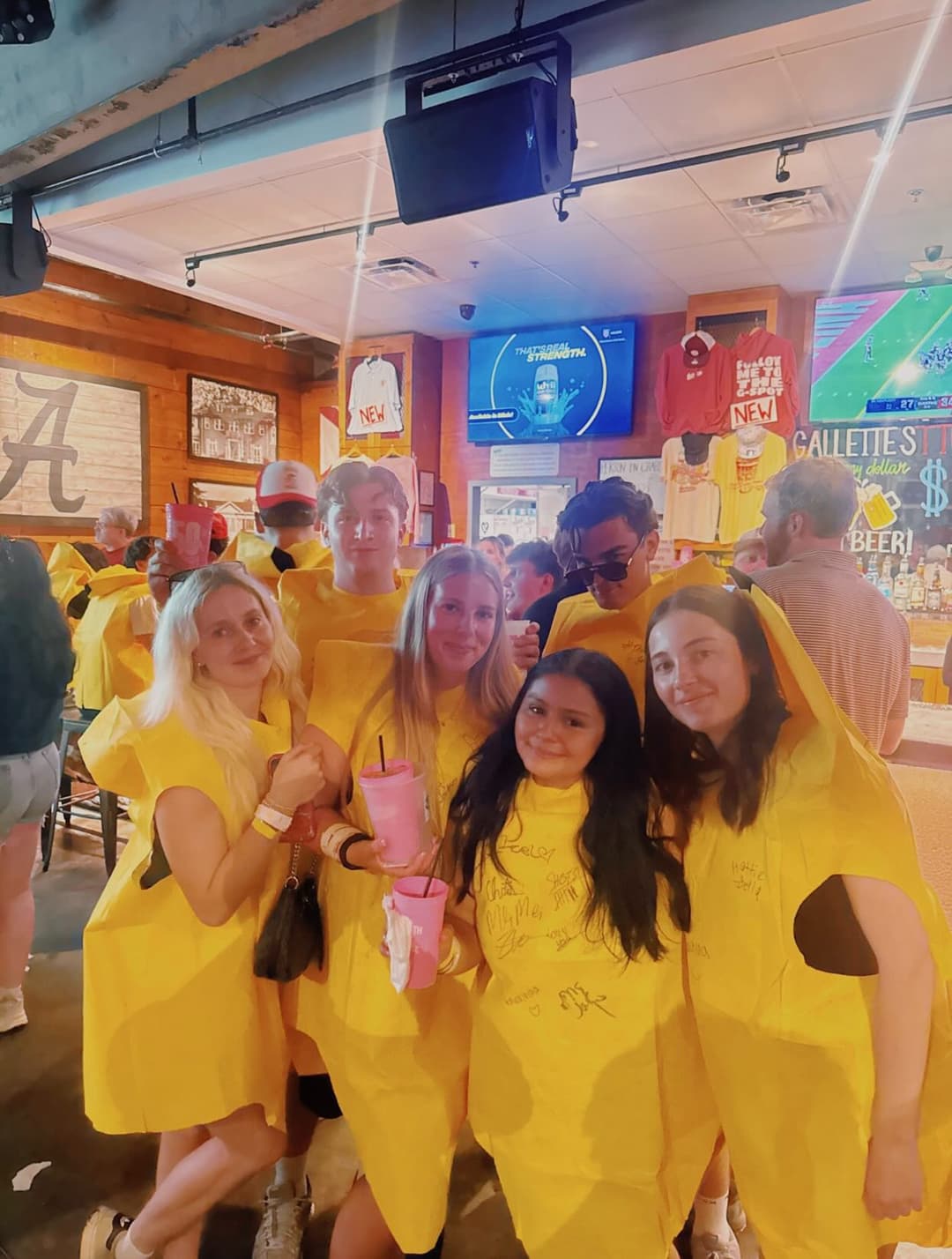
The English have a tendency to ask you where you're from, and after responding “America” or “the States,” they'll then say, “Where at?” This is usually a complete waste of time, as they’ve usually never heard of anywhere other than Los Angeles, New York, Chicago and Miami, and the whole exchange extends the entire interaction just long enough to make it awkward. The rare exceptions, of course, are extremely entertaining. Maybe once a day someone would hear “Alabama” and then very solemnly nod and say “Roll Tide.” This never stopped occurring even after leaving England and was a real bright spot over the course of the trip.
Getting from England to the continent is significantly easier than going from Ireland to Britain. There are plenty of ferries at different points along the English Channel. There's also the Chunnel, which is an underwater tunnel located under the English Channel and is one of the 20th century's truly great infrastructure achievements.
If you want to take a direct route from London to a major city, your best bet is the Eurostar, a bullet train that runs throughout most major cities in the EU. It's dizzyingly fast, which sounds great, but it books in advance most of the time, so you have to be careful. You can get stranded or end up being forced to take an odd non-direct route to your destination if the main link between where you are and where you're going is the Eurostar. We got lucky enough to get seats 15 minutes before departure from St Pancras, and soon enough we were off from London and blazing towards Amsterdam.
Amsterdam has a reputation as Europe's sin city. This might have had a point 20 years ago, but in today's world where cannabis use is no longer taboo and possession is scarcely prosecuted, some of the allure has rubbed off. That said, what you’re left with is the Venice of the north, one of the most truly beautiful cities in the world. Additionally, coffeeshops in Amsterdam are known for the cannabis products on their menus, making them a perfect stop before a museum if you want to experience high culture.
The Netherlands is small enough that it can almost feel like a city state to a visitor. You can conceivably bike the breadth of the entire nation with no great effort assuming you’ve got time to kill. Canals form a set of “rings” around the city, and it's filled with bridges, little alleys, small islands, and floating businesses, all very picturesque. It goes all out for Holiday decorations. The entire place is decked out in light and color. It looks a bit like Christmas does in Richard Scarry picture books.
The streets in the Netherlands are so narrow and the city is so compact that biking is far and away the most efficient form of transit. It’s also spectacularly easy for English speakers to get around Amsterdam. A couple of times I heard Dutch people just speaking English to each other absent any other non-Dutch speakers.
On the first night, we made plans to take a boat tour around that offered bottomless drinks. We hit a coffee shop beforehand, which would have been fine under normal circumstances, but a trifecta of issues confronted us about 10 minutes into the boat ride. A: This was not the bottomless drinks boat; it was the sober boat. The guy on the dock had made a mistake. B: Dutch weed is quite a bit stronger than we were used to, and frankly we’d combined it with some other stuff. C: The boat ride was an hour long.
Our tour group included an old couple who told us that they were uncomfortable with all the drug use going on around them and said they felt like it was “ruining the beauty of the city,” and boy let me tell you, you've never really had to lock in until you've had to convince elderly strangers that you’re sober while you can barely see straight. When we got off and told the operators we got put on the wrong boat, they offered to just put us on the unlimited drinks boat and we could do the tour again. It felt financially irresponsible to do otherwise, so we acquiesced.
We left for Germany the next day with the plan of going to the Cologne Christmas markets, admiring the cathedral and drinking some of the allegedly superior beer available there. Cologne is a peculiar city in a number of ways. For one thing, even though it’s one of the most famous cities in Germany, it seems very un-German, at least in the popular understanding of what Germanness is. The locals are a lot more freewheeling than the national norm, and the city is considered very culturally outward-looking, a fact sometimes attributed to its history as a major trading town along the Rhine from which it was constantly exposed to novel people and ideas.
The city resembles a town made in Minecraft, all blocky structures in shades of grey that no doubt looked very futuristic at the time but now just look cold. It’s not without its charms though. Here and there, pre-war buildings survive and they’re invariably pleasant. After you wander between the brutalism for a while, each one is a relief. The streets near the Rhine are full of strollers and shops, and it’s a perfectly relaxing place to sit and watch the boats go by while you drink something.
We went to the Christmas markets, of which there are several. I’m not really one for souvenirs, but my girlfriend very much is, so we browsed the stalls for a long time, ate pretzels (excellent), bratwursts (also excellent) and drank Gluhwein, which is a type of mulled wine that’s flavor is somewhere between antiseptic and poison. There was plenty of Kolsch, a great traditional German beer, which more than made up for the taste of the Gluhwein.
One of the markets was located right underneath Cologne Cathedral. I’ve seen Saint Paul's, Notre Dame, Sacre Coeur, the National Cathedral in Washington and St. Patrick's in Manhattan. None of them top Cologne Cathedral. For one thing, it’s enormous. For another, it's utterly symmetrical and the facade is so perfectly and surreptitiously carved so that no matter what angle you look at it from it doesn't fail to impress. In a city mostly destroyed in World War II, we should count ourselves lucky that this otherworldly Gothic structure survived.
Germany itself and its inhabitants are frankly too similar to their cousins here in the States for me to draw any interesting observations. German is a lot more phonetic and easier to take a crack at than French or Dutch though, so I ordered food in German multiple times only to look like a complete tool when, after they paid me the kindness of responding in German and humoring my attempts at practicing the language, I was left blinking like a deer in headlights since I had no gameplan beyond the first sentence. Anyways, nice people.
Paris was our last stop. As we’d saved a lot of money by this point, we decided to stay in Paris for longer than anywhere else. We splurged on accommodations for Hotel Providence Paris, which absolutely rocked. We arrived tired, sore, and later than our check-in time, and the staff took care of every single thing we needed. They bumped our room up to a balcony suite, took care of our in-town travel planning and after hours on the road the hotel restaurant was literally out of this world. I cannot endorse the place more enthusiastically.
A lot of people get all misty eyed and wistful about Paris, with an equally large number of people annoyed by people who do so. I regret to inform you, reader, that I am in the former category. Paris lives up to the legend, and then some.
Paris’s real charm is less in its variety of activities to do and more in its accommodation for the absence of activity. Service is slow, but why would you want it to be fast? Are you in a hurry? Don't be. With ashtrays placed on nearly every table in the city, everywhere in Paris is a perfect place to have a drink and smoke a cig. Smoking is one of the principal nonactivities in Paris.
Whoever said the French are rude must’ve not been a smoker. It’s a perfect icebreaker and immediately establishes your credentials as a well-adjusted traveler to those nearby. No Parisian would refuse to share one with you if there's a shortage. On the subject of the locals' rudeness, I am a defender of the essential nobility and character of the French people. We were continuously treated well, and at no point was there even a hint of snobbery.
An episode: One night, we were out late and desperate for rest and restoration. I asked a man waiting for the metro if there were any good cafes nearby. He responded that he was a chef himself and that I could hardly have asked a better man. He gave me an address and said that if my woman (his words) cared for sweets, that I would do well to order the chocolate mousse. We arrived and took the only available seats outside next to an old man smoking by the door. While we puzzled over the menu, he overheard us and asked if we spoke French. When I replied that we didn’t, he nodded, drew up his chair between us and explained carefully what each dish was and what drinks he thought would suit our occasion. He called over a waiter, gave him some sort of instructions I couldn’t understand and vanished inside. As the chocolate mousse arrived, the old man who was smoking by the door returned to ask us how we heard of the place. When we told him it had been recommended to us, he seemed very pleased. He invited us to stay as long as we liked and to let him know if we needed anything else. “You young people should enjoy your holiday here as best you can,” he said. “You only get to be young for so long.”
He was the owner.
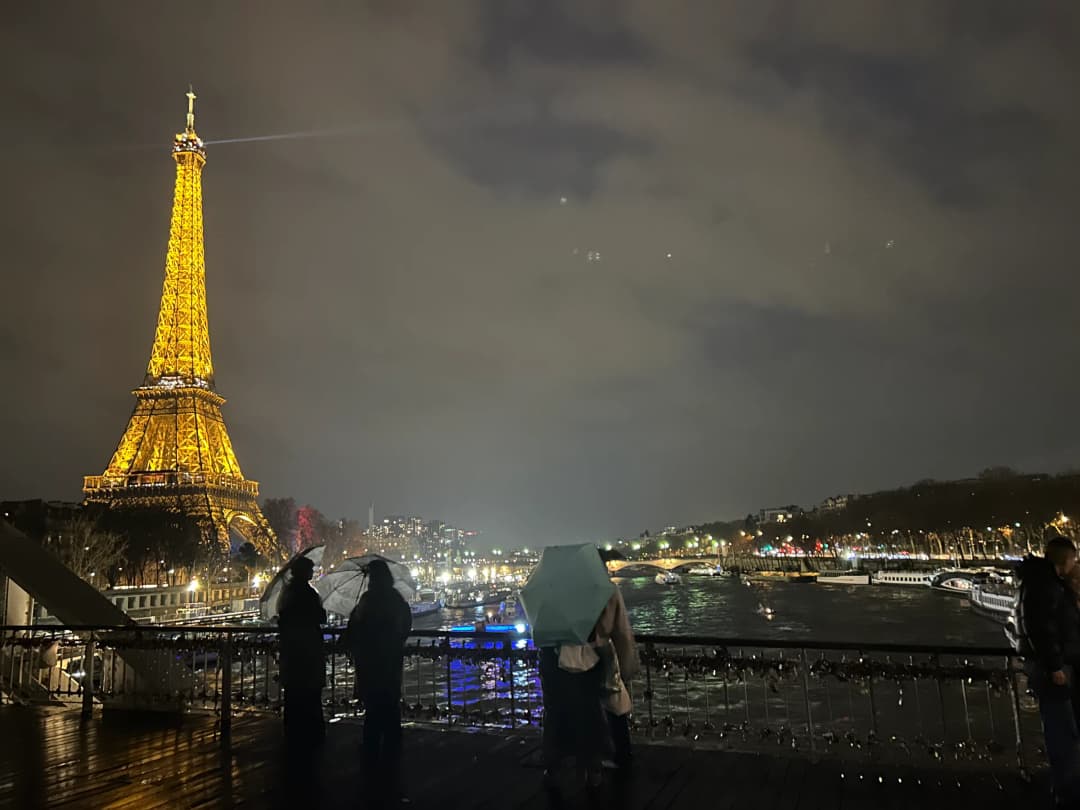
In December, the sun sets earlier in Europe than it does in the States. In the previous cities, I felt like I was missing something as a result of that, but not in Paris. Some cities, like Las Vegas and Hong Kong, are meant to be seen at night. The lights are warm and gold, not the hospital white fluorescence that's so in vogue with urban planners today.
As you walk along the Seine, you can see the rotating spotlight from the top of the Eiffel Tower far in advance of the structure itself. When you round the National Assembly, it leaps out so prominently that you wonder how it was possible not to see it before. We stared at it for a long time from Pont Alexandre III, a bridge over the river. It was exactly as it appears in all the videos and pictures I had seen before.
You may know something exists, but you’ll never feel truly certain until you confirm its existence with your own eyes. When you assume you’ll never get to see something that you’ve heard about for so long, it starts to feel like a myth. Once you’re finally there, it ceases to be exciting and instead becomes a relief.
It's a pleasant anticlimax. Like going into an exam and finding the material easier than you expected. The Mona Lisa is right there in front of you. Sure, it's so crowded you can barely see it, but it's there. And if it's there, it stands to reason that so are the northern lights, the Great Wall of China, Margot Robbie, true love and growing old together, religious experiences, and a million other fantastical things you'd heard of and read about but never saw.
After three days in Paris, we took a cab to Charles de Gaulle Airport, and about 20 hours later we touched down in Chicago. It seemed as if nothing had changed in the past two weeks other than the date. It was Christmas Eve and there were carolers in the terminal. A woman with tired eyes told her son to play nice, and an older man with a USS Kitty Hawk hat hugged what must have been his daughter and granddaughter as they exited the gate. After a short connection to Birmingham, I was reunited with my family for the holidays. I fell asleep in my childhood bedroom with two hours until Christmas Day.
In Paris, we left a love lock on the fence in front of Notre Dame next to the statue of Charlemagne. The authorities consider the tradition of couples leaving padlocks around Paris a nuisance and prune them off every few years. In all likelihood, the lock will be gone from the fence within the next decade. But even after it's been disposed of, it will still be there. In a landfill, perhaps. More likely recycled and turned into a steel beam or some other dull yet noble implement of society. Even if it's scattered and transformed, the click and rattle of the lock on the fence will stay in my mind.